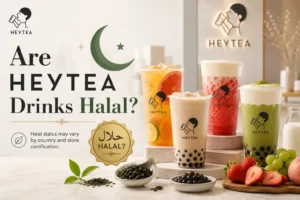
Are HEYTEA Drinks Halal?
HEYTEA (also known as 喜茶 in Chinese) is one of the world’s most popular modern tea drink brands. Established in 2012 in Guangdong, China, the company brought innovation and change to the “new-style tea” (新式茶饮) market by introducing cheese foam teas, fruit teas, brown sugar drinks, and top-tier milk teas. HEYTEA’s thousands of outlets around the world have garnered an enormous following from consumers around the globe, many of whom are Muslim and practice strict halal dietary laws.
For the observant Muslim the main question is, are HEYTEA drinks halal?
The answer is, it depends on the type of drink, where it was produced, the ingredients used at that place, and if it has been officially declared as halal. There is no universal ‘yes’ or ‘no’ across the brand. There is a detailed breakdown below with evidence for every section.
see more : Why is HEYTEA so famous?
Understanding Halal Requirements for Beverages
According to Islamic law (fiqh), a beverage is allowed to be consumed if it fulfills the following basic requirements:
- Does not have any alcohol (ethanol) in the intoxicating amounts.
- Free from haram (pork, non-zabiha meat etc.) ingredients.
- It is free of any haram ingredients like some emulsifiers, flavorings and gelatins.
- Does not contain haram substances when preparing, storing or serving.
- Haram items, in particular alcohol or pork, may not be introduced into the area to cause cross contamination.
Non-alcoholic drinks are assumed to be halal, unless proven otherwise. Many modern milk teas and fruit drinks, though, have additives, flavorings, dairy, and in some cases, alcohol-based extracts that must be looked at.
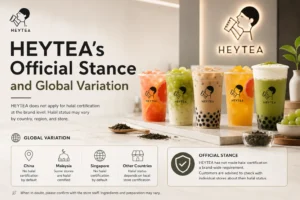
HEYTEA’s Official Stance and Global Variation
There is no universal worldwide Halal certification of HEYTEA. Overall, the company’s stance, as seen in its official social media and customer service replies, in various markets is:
The local authorities (JAKIM in Malaysia, MUI in Indonesia, ESMA or local municipal halal boards in the GCC) have been approached by many HEYTEA outlets in Muslim-majority countries to obtain halal certification.
There is no national system of halal certification for non-meat products such as tea drinks in China where the overwhelming majority of stores are situated. There are no officially certified halal Chinese HEYTEA stores, but many individual ingredients can be considered halal.
Store-by-store or no certification in Western countries (UK, USA, Canada and Australia). Occasionally, alcohol-free flavourings are used and Muslim staff; however, this is generally not formally certified.
The question of what ingredients might render the HEYTEA drinks non-Halal is addressed by this resource.
There are several parts of HEYTEA’s menu that need to be looked at closely:
Liquid foam cheese, cream crown or mousse.A cheese mousse or cream crown.
1. Cheese Foam / Cream Crown / Mousse
The foam will usually include the following ingredients:
- Cream cheese or cream
- Milk
- Sugar
- In some cases stabilizers or emulsifiers (E-numbers)
Today, most of the cheese and milk in the larger chains are of microbial rennet or vegetarian rennet, and not animal rennet from pigs or from cows that haven’t been slaughtered according to the Halal law. But, if not certified, there is no assurance. HEYTEA in certified markets, Malaysia uses halal certified dairy.
2. Flavorings and Extracts
Concentrated flavorings are added to many fruit teas, milk teas and seasonal drinks. Some of these may be:
Sugar-free, alcohol-based natural flavours (which are commonly used in the food industry)
Questionable artificial flavours (carriers)
HEYTEA has promised to change to alcohol-free flavorings in several markets where it is required by local regulations. This is typically enforced in the Middle East and Southeast Asia.
3. Toppings and Add-ins
Brown sugar pearls (boba) – usually halal – (tapioca, brown sugar).
Fruit pieces, jellies and mousses, typically plants and safe.
The processing aids used in lychee processing or in some fruit concentrates may require verification.
4. Tea Base
Any amount of tea leaves (black, green or oolong) are considered as halal food. The tea leaves we source for HEYTEA are high quality and present no problem.
Country-by-Country Situation (as of 2026)
Many outlets of the HEYTEA chain of restaurants are certified as halal by JAKIM in Malaysia. The company has put in a lot of efforts to comply. In general, Malaysian Muslims can be 99.9% sure of the standard menu, although they should always consult the particular store’s certificate.
Indonesia: There are several stores with the MUI halal mark. In Indonesia, strictly regulated by the halal rule, certified branches are safe.
HEYTEA has aggressively grown in the GCC, and specifically in the UAE, Saudi Arabia and Qatar. The majority of outlets are based on local halal requirements or are certified by ESMA/Halal. Any cheese foam and milk teas sold here are generally considered to be halal.
China (Mainland): Most of the stores (1,000+) are not certified as Halal. Although pork is not mentioned and alcohol is not an ingredient, the fact that the drinks aren’t certified, are processed in the same facilities as pork, and may contain non-halal dairy or flavoring makes it a gray area. It is not consumed by many Chinese Muslims or by many who drink tea with it, who drink tea plain.
Certification is restricted in the United Kingdom, the United States, Canada and Australia. Strict observers tend to steer clear of the cheese foam and creamy drinks at some establishments that claim to use halal ingredients and have Muslim staff, but do not have a certification from a recognized organization, such as HMC, HFCE, IFAN etc. For some, plain fruit teas or fresh milk teas might be OK.
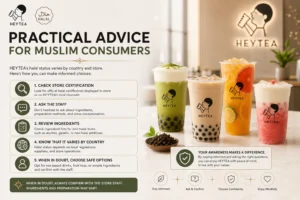
Practical Advice for Muslim Consumers
The following are practical tips for Muslim consumers.
- Always look for the visible halal certification at the shop or on the brand’s local website/app.
- Preferring certified markets (Malaysia, Indonesia, GCC countries, Singapore) to non certified markets.
- If you’re not sure, choose simpler beverages, such as fresh fruit teas, plain oolong tea, or no-cheese foam or cream tea.
- Be sure to call the local HEYTEA team or go to the HEYTEA’s social media for the most up-to-date ingredient lists.
- Consider using Muslim owned review sites or apps such as HalalTrip, Zabihah or Eat Halal which occasionally feature certified branches.
- Many Muslims do not drink tap water in China and prefer to drink only sealed bottled water or bring their own tea.
HEYTEA’s Efforts Toward Halal Compliance
HEYTEA has grown more cognizant of the world’s Muslim market. The company has:
- Reformulated some flavours to be alcohol-free in the international markets.
- In conjunction with halal certification organizations from the Middle East and Southeast Asia.
- Certified stores staff trained on cross-contamination prevention.
- Deleted or substituted in doubt some ingredients in menus of countries with Muslim majority.
It is difficult and expensive, however, to guarantee 100% globally Halal, as this is a brand with a vast supply chain and most of it is based in China.
Conclusion
Do HEYTEA drinks comply with the halal standards?
Yes, many outlets in Malaysia, Indonesia, UAE, Saudi Arabia etc. are officially certified outlets.
Not strictly allowed for those observing with more strictness in most countries, but may be allowed with plant based or certified dairy where cheese foam is not used in the drink.
Uncertain or to be avoided by strictly observant Muslims in the mainland China and/or by western branches that are not formally certified.
The brand isn’t a bad name in itself. The main products of HEYTEA are tea, milk, fruit, sugar and tapioca, which are generally halal. The primary concerns are sourcing dairy, flavor carriers and non-certified dairy.
Just like all international beverage brands, do your homework on HEYTEA per location for Muslim consumers. If the store has a recognized halal logo, and the staff can attest that the drinks are produced without alcohol, then it’s usually safe to drink. With the expanding population of Muslims and a demand for high quality halal products, HEYTEA will likely continue expanding its certified footprint. So for the time being the answer is: Some HEYTEA drinks are guaranteed halal, others are not.