HEYTEA vs Starbucks
Comparing HEYTEA to Starbucks is a fascinating comparison, as the two brands represent different eras, cultures and strategies in the global beverage market. Starbucks is the one of the most well-known coffee establishments in the world, and this building is founded on consistency, premium positioning and the “third place” lifestyle concept. Unlike HEYTEA, which is the newer Chinese tea brand that exploded in growth by making traditional tea a trendy, high quality, and socialized product, HEYTEA is a larger Chinese tea brand. These two comparisons show not only two companies, but two very different strategies for building a brand, creating a product and providing a consumer experience.
Product Focus
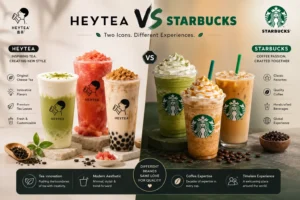
Starbucks and HEYTEA are offering two types of drinks. Starbucks is focused on coffee, espresso drinks, Frappuccinos, teas and food, including pastries and sandwiches. Its core identity has always been related to the coffee culture, and particularly the concept of having ‘café coffee’ available to the mainstream consumer. HEYTEA mainly concentrates on tea drinks, particularly modern tea drinks consisting of fresh tea, milk, cheese foam, fruit and other ingredients. It is a well-known style that is often referred to as “new-style tea,” blending traditional Chinese tea with modern tastes and aesthetics. In this sense, Starbucks is a brand of coffee worldwide and HEYTEA is a brand of tea that is a challenger brand.
Origins and Growth
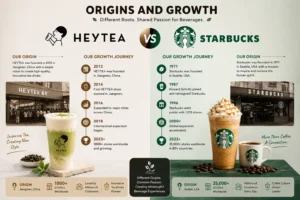
They come from extremely different market environments as well. Starbucks opened its first store in the United States in 1971, and slowly grew into a worldwide giant company. It thrived under the influence of specialty coffee culture, urbanization, and premium coffee café experiences. Starbucks developed a solid global supply chain, a standardized store design and a strong brand image over the years. Launched in China in 2012, HEYTEA came to an extremely competitive and fast-paced drinks market, where tea drinks and local consumer preferences played a dominant role. HEYTEA did not aim to cultivate a universal coffee culture gradually, but rather their target audience, young people in China, were already tea drinkers, focused on personalization and preferring novelty. It was more social media-driven, more limited-store and more aspirational-brands, and its growth was much faster.
Brand Positioning
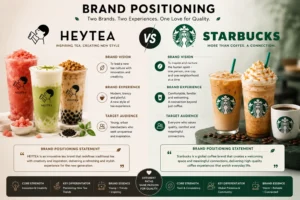
There are a few significant distinctions between the two brands, one being the positioning. Starbucks is a high-end mass-market brand: it’s a high-end brand, yet it still has to appeal to a wide range of people. It isn’t as cheap as a local café, but customers want the same high-quality service, same menu and same comfortable environment. Starbucks stores can be a place to work, meet or relax. HEYTEA is more of a stylish, trendy and high-quality youth brand. It goes beyond the purchase of a beverage, it’s a lifestyle movement. The novelty, aesthetic packaging, and modernity and cultural relevance are the key factors to HEYTEAs appeal. Its customers are also younger and more experienced in certain markets, particularly in China.
Product Innovation
Besides, the two brands differ with regard to product innovation. But Starbucks is innovative because it continuously adds more items to its menu, seasonal items and even localizing its products for specific regions. It has developed matcha drinks and regionalised teas, for instance, to local taste. But Starbucks is known for its innovations in a pretty stable system. It offers coffee and caffeinated beverages. In terms of the innovation, HEYTEA is more radical. It popularized the movement of ‘cheese tea’ and will often play with various fruit teas, cheese foam and tea blends. Its offerings tend to be a bit edgier and more eye-catching. This is what makes HEYTEA more trendy, and Starbucks more systematic and predictable.
Customer Experience
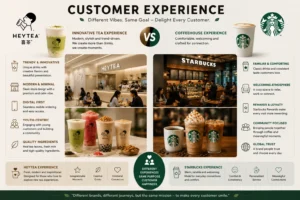
The shop experience of each brand is also quite different. Comfort, consistency and ‘third place’ design are Starbucks’s first focus. The store should be like a home away from home or an office away from the office. Sitting, ambiance and the relatively longer stay times are factors of importance. People aren’t just coming to Starbucks for a cup of coffee, they’re coming to learn, work, or socialize. HEYTEA stores, however, will more likely focus on an experience that’s younger, more high-end and social media savvy. It can be sleek, minimal and very photographic. The brand experience is often based on scarcity and excitement, rather than engagement for a long period of time. Customers are more likely to purchase a drink to take out or share on social media than stay for hours in.
Brand Identity
Brand identity is at the heart of why each company is so much closer to its audience. Starbucks has grown a lifestyle brand that is known and traditional and represents a desired daily indulgence around the world. The green colour of its siren logo makes it immediately identifiable and its branding language promotes the importance of community, personalisation and quality. Starbucks can sound local in a lot of countries, but it’s able to do so, while maintaining its personality, by adapting enough to each market. HEYTEA, by contrast, is closely linked to the Chinese youth culture and contemporary urban lifestyles. It is an expression of a newfound confidence in Chinese consumer brands, and it seems a local brand can stir the same kind of excitement as global brands. The purchase of HEYTEA is also a representation of taste and awareness of the trend for many consumers.
Global Expansion
Starbucks is clearly at an advantage in terms of globalization. It’s an established, global brand, present in dozens of countries and decades of experience. It has a much greater global brand recognition. While Starbucks is in a consolidation mode, HEYTEA is still in more of an expansion stage and its global footprint, though rising, is still less than Starbucks. Opening stores in other countries is just the first part of the equation for HEYTEA; the other part is being able to make its brand resonate with people in other cultures, whose tea taste, price points and beverage habits can vary. It’s a problem that Starbucks has already addressed by adapting to markets. HEYTEA has yet to demonstrate its model can successfully travel.
Operations and Scale
In terms of scale, supply chain management and standardization of its stores, Starbucks is a model to follow. It has a well established training system and a very well developed database for their sourcing, logistic and quality control system. This enables it to run effectively in thousands of stores. HEYTEA is also savvy but relies more on the brands’ heat, product freshness and consumer attention. It is frequently based on keeping things exclusive and exciting, as this may be more difficult to scale than the consistency-based Starbucks system. Starbucks can grow by repetition, HEYTEA must grow and maintain a sense of novelty.
Pricing and Value
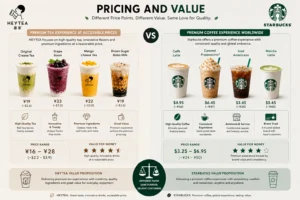
There is a premium pricing for both brands, however the value proposition is different. Starbucks charges for the coffee, charges for the customisation and charges for the environment. The reason why customers accept the price is because they think that they are paying for the whole experience. Premium tea ingredients, craftsmanship, trend and brand status cost HEYTEA a lot of money for the premium tea. The market in China is very competitive with a lot of very cheap products available which have to be matched by the quality and social value of the HEYTEA. Starbucks does it with its global familiarity, HEYTEA does it with its uniqueness and desirability.
Consumer Psychology
Understanding consumer psychology can be helpful in understanding why each brand is successful. Starbucks attracts those who are looking for a familiar and reliable experience and know what to expect at one of the many locations around the world. While a Starbucks drink may be indulgent, ordering it is often instinctive and a way of doing things. People who are looking for discovery, novelty, and involvement in a trend are the target of HEYTEA. It will be more effective in creating excitement for the introduction of a new product or new flavour. Starbucks is a place of trust, HEYTEA is a place of surprise. Starbucks fosters loyalty by being the same, while HEYTEA fosters buzz by being different and relevant.
Cultural Significance
From a cultural perspective, the two brands symbolize different beverage traditions. Starbucks is a mark of the globalisation of coffee culture and the normalisation of café life in urban area. The modernization of the tea culture and the power of Chinese brands to re-invent the traditional culture for the new generation is the essence of HEYTEA.The essence of HEYTEA is the modernization of the tea culture and the power of Chinese brands to re-invent the traditional culture for the new generation. Sure, they’re not just competitors, they’re culturally; they’re expressions. One is a western café lifestyle exported the other is an oriental tea tradition in the digital era.
Conclusion
In the end, the brand that is “better” is really determined by the consumer’s values. When someone is looking for comfort, consistency, familiarity around the world and where to stay, Starbucks is more of a better bet. For those looking for current and popular tea flavors, an unusual tea experience, and a youthful experience of the brand, HEYTEA might be more of an attraction. Starbucks wins on scale, reach and maturity. The best thing about HEYTEA is its innovation, freshness and youthfulness.
So, to sum up, HEYTEA is compared to Starbucks in terms of successful and contrasting brand philosophies. Starbucks is the worldwide giant of coffee, uniformity and lifestyle branding. The modern tea disruptor, HEYTEA, has transformed the tea experience in China into a premium and fashionable one that is highly shareable. Both brands know that beverages are more than just beverages—they are a symbol of identity, taste and a sense of community. It’s a competition that’s an example of just how strong beverage brands can be when they’re rooted in product design, emotion, and experience.
Summary: I used clear and distinct headings and paragraphing for readability.