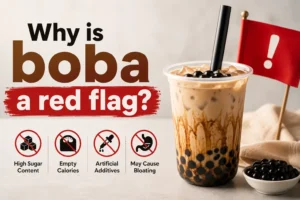
Why is Boba a Red Flag?
The term “boba is a red flag” has already gained traction on social media, dating applications and even casual chats, though the phrase is frequently utilized in an exaggerative or playful manner, as opposed to a critical judgment. “Boba is a red flag” is a common phrase and it typically doesn’t mean the drink is bad. Rather, they are laughing at the type of people that drink boba, at the stereotypes of people who enjoy buying bubble tea, or the trends related to an online culture. But in truth, boba isn’t necessarily a red flag. But for some personality traits, habits or social behaviours, it’s a shorthand for the internet, a survey expression people use when they find something suspicious, overdone or cringes.
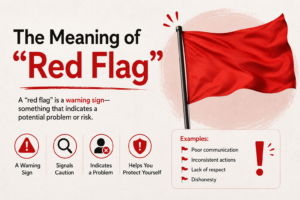
The Meaning of “Red Flag”
It is important to grasp the meaning of “red flag,” before you can grasp why it may be considered such.To really understand why boba might be considered a red flag, it is helpful to first understand what the phrase “red flag” means. In everyday use, a red flag is a warning that may indicate a problem, unhealthiness, or something to be aware of. This is a term that is commonly used in relationships to indicate behaviours that indicate potential issues. However, on social media, the term is sometimes used more loosely and humorously. Anything out of the ordinary, trendy, or stereotypical is considered a red flag for humor. Which is why it’s not that unusual to find a few boba-obsessed people criticizing their boba drink simply for being a boba tea.
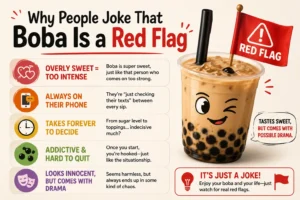
Why People Joke That Boba Is a Red Flag
The first is the notion that bubble tea is a symbol of the dating culture and stereotypes of online dating personalities.The first is the association of bubble tea with online dating personalities and culture. Some view boba as a bit of a fad or a performative act, particularly if it’s prominently displayed in selfies or dating profile pictures or on social media influencers. It’s not the joke on the drink, it’s the joke on the image. Others perceive boba as a specific style, that’s curated, youthful and very social media centric. For this reason, they might jokingly tell people that if they like boba it’s a sign they’re a scam.Therefore, they might jokingly tell someone that if they like boba, it’s a sign they’re a scam, just as they might jokingly tell someone they don’t like matcha or astrology or over-priced coffee.
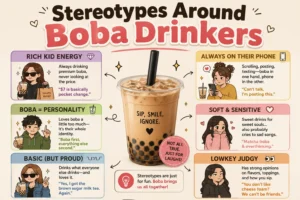
Stereotypes Around Boba Drinkers
Most of the “boba red flag” joke is rooted in the stereotypes surrounding those that drink it. Others think that boba freaks are just trendy, social media addicts or possess certain personalities. Some people mock bobas drinkers as the kind of people who make every walk into a photo shoot, particularly when the boba is adorned with pretty designs and a fashionable straw. These stereotypes are untrue for all people, but are widely used as a form of Internet humor. Actually, people from all walks of life like boba for various reasons and you don’t have to be suspicious of a sweet tea drink. However, stereotyping is also a common occurrence online as it can easily be made into memes and jokes.
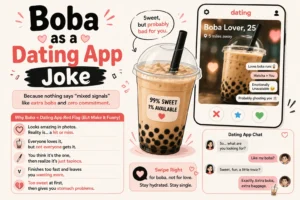
Boba as a Dating App Joke
Dating app culture is one of the biggest reasons why boba is referred to as a red flag. There have been some complaints that having a lot of boba photos on the profile can seem unoriginal and too curated. Some, however, believe that too much mention of boba can be used as a personality trick, with the individual making one of its core attributes a part of their personality. That’s where the word “red flag” comes from. While it is possible that people don’t dislike boba, it is possible that they do, and it’s possible that it is a sign for someone who is perceived as basic, trendy, or too much of a bother to fit a certain image. Obviously, this varies from person to person and can be unfair, however dating apps make out little things into big personality judgments.
The “Basic” Aesthetic Stereotype
Boba is often referred to as a red flag because of some refer to it as a “basic” aesthetic. This means a costume or custom that is deemed to be normal, conventional or trendy. In particular, boba is lumped in with other trendy life hacks like iced coffees, avo toast, and cafes with pastel hues. Those who do not favor overly popular fads might laugh at the notion that boba is a red flag due to its predictability or polish. But mainstream doesn’t necessarily mean bad. It simply means it is in vogue. The reason the joke plays is that people tend to tease things that they think are too trendy or too apparent in internet culture as being “basic.”
Cultural and Social Context
Boba holds cultural significance as well, particularly to Asian communities where bubble tea originated and became popular. To many, boba is not a passing fad but a drink that is familiar and commonplace to them and a part of their everyday existence, family gatherings, or their cultural identity. If you say a red flag without knowing what’s going on, it appears to be an attitude of ignorance or disrespect. In many places, bubble tea isn’t an internet culture, it’s a culture. So that online users who mock the boba as “a red flag” is nothing but a joke, while the other side regard the joke as shallow due to the drink’s cultural significance to millions of people.
When the Joke Becomes Too Serious
While often phrased with a bit of fun, jokes of this sort can be unfair when people begin to take them as serious assessments. Boba is a very subtle way to indicate a person’s character, values and relationship potential. It’s simply a drinking choice. The term too seriously is a warning sign that people may mistakenly use to label as a social problem what is really harmless. This can be particularly annoying when the joke becomes a stereotype, and is repeated so many times that people believe it. That said, the red flag designation isn’t just about the tea, it’s about the humor of the online community.
Why the Meme Is So Popular
The appeal of this joke may be that it is simple to understand and share. Boba is both visually identifiable and popular, and has a strong association with social media culture. That’s the stuff of memes, right? One of the ways Internet jokes work is that they take something that is harmless and make it into a dramatic statement. It’s also kind of a joke because it’s so obviously hyperbole to say that boba is a red flag. The point of the joke is that people know that bubble tea is not harmful or sinful. It’s based on a contrast with a harmless beverage and the serious-sounding “red flag” phrase. It’s its absurdity that’s what makes it spread.
What the Joke Reveals About Online Culture
The “boba red flag” jest is additionally a window into online culture’s love of giving significance to minutiae. To guess a person’s personality in the digital world, people tend to be judgemental based on their food selection, clothing, and social media behavior. Boba emerges as a symbol of this tendency, as it is linked to aesthetics, trends and identity performance. The punchline plays on the tendency of online interactions to involve the literal interpretation of a simple preference, in the sense that it is believed to be a statement of fact. This can be fun, but can also foster superficial assumptions. Not all bubble tea enthusiasts are aiming for a specific impression, and not all faddy habits are worthy of being used to evaluate someone’s personality.
Final Thoughts
But why is boba a red flag? The brevity of the answer is that typically it isn’t a red flag per se. The term is primarily a spoof on social media trends, dating app cliches and the concept that “bobacurious” or “bobas” is often equated with a “basic” or “over-curated” aesthetic. Some people use it for teasing others, saying that they are trendy or predictable; however, it is more about online culture than it is about the drink. Boba is just a popular drink by millions of people, and enjoying it is not a bad thing to say about anybody. The term is even more of a testament to the power of the internet to turn the mundane into the hyper-symbolic.